What exactly is the behavioral science community doing if not immediately testing the first elemental, unified, and falsifiable model in 150 years?
Tongue-in-cheek post follows…
Many scientists, apparently, may not get the humor.
After just one week of being published—nobody expected a parade.
Not even a “congratulations.” In fact, we expect nothing other than testing.
As a falsifiable framework—UBM, the first unified and elemental one ever—it isn’t in need of producing more empirical evidence, tests, or trials.
It is not a clinical therapeutic intervention.
This is what falsifiable frameworks do: they invite trials and tests.
They don’t produce them.
Get it?
So, if you’re offended, apologies—do you see the number at the top? The days this framework has remained unbroken, unfalsified.
That means, thus far, it’s dare we say, extremely solid.
1,100 downloads. Four months since preprint.
Thanks for reading—and for keeping a sense of humor! 😉 🙏

Last week, in what can only be described as an act of reckless clarity, we published a white paper on the Unified Behavioral Model™ — the first model of its kind to be:
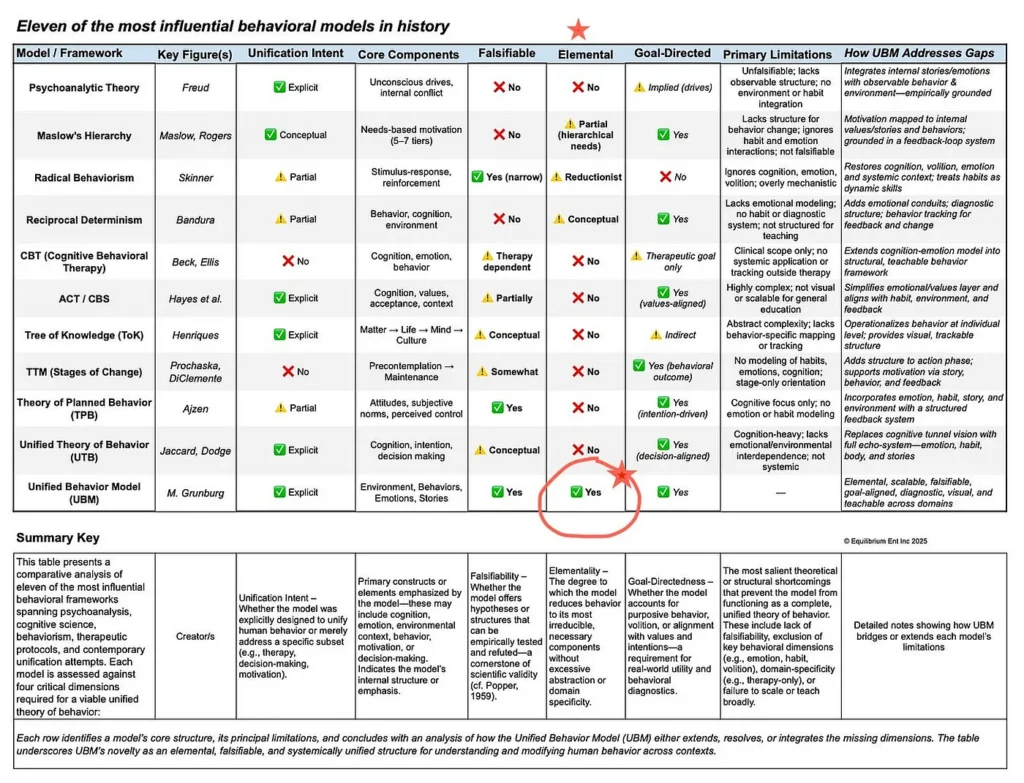
✅ Unified (yes, really)
✅ Elemental (think: first principles, not mood boards)
✅ Goal-directed (yes, even doomscrolling counts — try to think of a behavior that isn’t serving a purpose. Go ahead, we’ll wait.)
✅ And… wait for it… FALSIFIABLE (aka science’s platinum badge of honor — spoiler alert: there isn’t a single other falsifiable behavioral model in existence that we know of. We’ll keep looking.)
Naturally, we assumed this would spark a scholarly stampede.
That Harvard, Stanford, and a rogue delegation from the Vatican would show up at our door with flowers, grant money, and a ceremonial lab coat.
But alas —
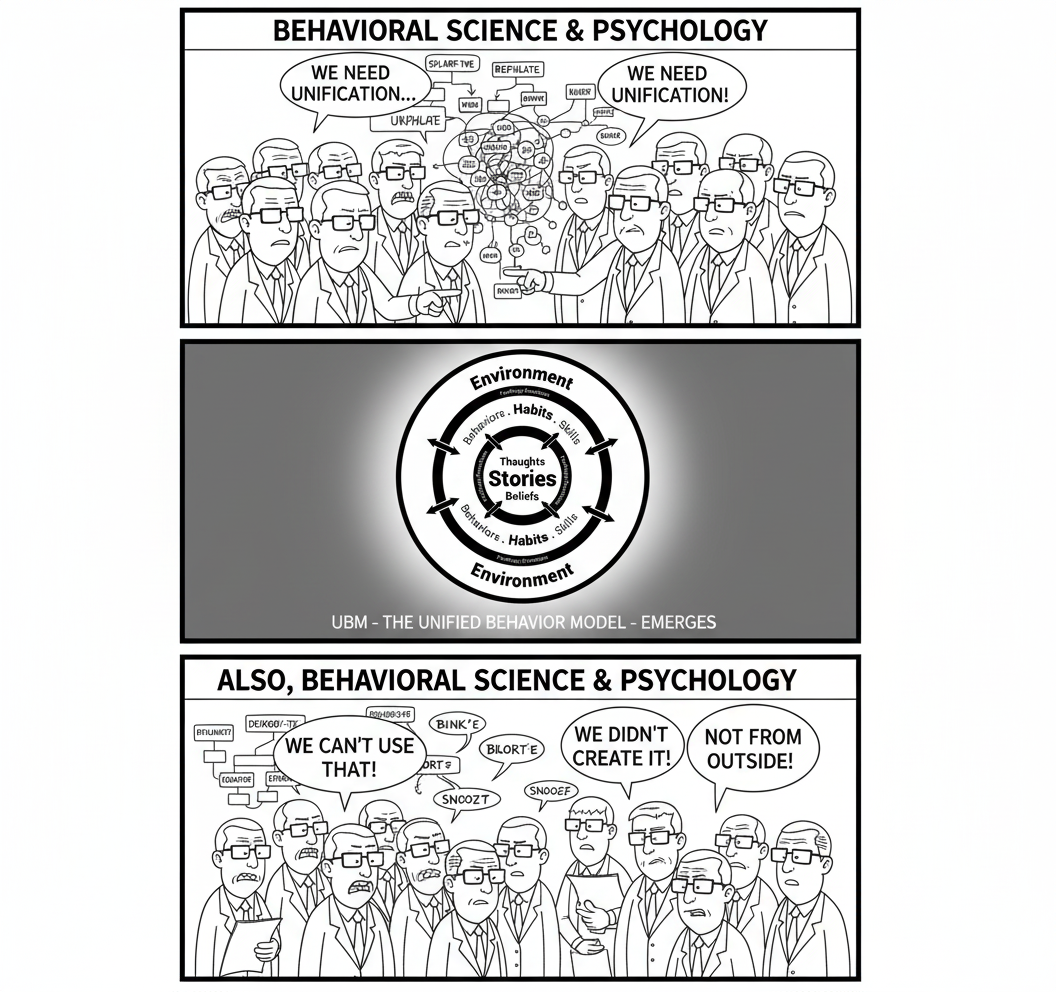
No ticker tape. No confetti. Just the soft chirp of crickets and a polite email from Zenodo saying, “Congratulations on the upload.”
Of course, this raises some questions.
What exactly is the behavioral science community doing if not immediately testing the first elemental, unified, and falsifiable model in 150 years?
If you’re thinking: UBM needs more empirical evidence first. It requires peer review.
To be clear, we’re ALL FOR MORE TESTING and ADDITIONAL EVIDENCE.
That said, the beauty of a falsifiable framework lies in its simplicity: It requires only one thing — DISPROOF.
That’s the essence of falsifiability. Falsifiable frameworks aren’t treated like clinical interventions.
They don’t wait for trials — they INVITE them.
By design, they exist to organize, to clarify, and to be tested. Hence: the “No Fifth Element” Challenge.
This is why the experts themselves—the behavioral scientists—refer to their field not as a true science, but as “only the hope of a science,” “pre-paradigmatic,” and “incoherent.” These are not my words—they’re theirs.
For as long as psychology and behavioral science have existed, they have lacked organization and clarity. What they need—and have always needed—is a unified framework.
This is the point: IF any scientist, anywhere, can disprove the model — if there’s even one missing piece, one necessary fifth element — we can ALL go home.
That’s the beauty of science: truth invites — and endures — scrutiny. The Unified Behavior Model (UBM) is exactly what its name implies: a unifying framework.
Let’s be clear: UBM isn’t here to replace any model, method, or therapy.
It’s here to connect them — to make diagnosis faster, integration smoother, and direction clearer.
It’s not here to compete. It’s here to UNIFY.
The UNIFIED BEHAVIOR MODEL IS A DIRECT RESPONSE, born of necessity—from the field’s long-standing (dare we say, forever) call for a unified framework in behavioral science.
The Unified Behavior Model (update):
Now over 4 months old, with 1,100+ downloads and counting.
And yes—you guessed it— It remains unbroken, despite multiple attempts at falsification by prominent behavioral scientists.
The tests keep coming.
Next up: Unified Behavior Model “Red Flags”
Notice—none of the below-stated concerns or “red flags” re: UBM are scientific.
UBM “Red Flags”? Why They’re “Interesting”
Thus far, four have been expressed.
- No Prior Papers?
Accurate. The author (MG), at this point, is one and done ; ). And, there’s a crucial difference between academic citations and twenty years of practical training, coaching, deep research, and writing.
- Origins outside of Academia?
Turns out that’s a significant asset when it comes to solving long-standing issues. Hence the phrase —outside the box. History shows us that breakthroughs—arise from the fringe: a Stanford article: breakthroughs and the To Discover Breakthrough Ideas, Look to the Outsiders. - Money?
This one’s very cute. It seems that every scientist who cries foul over a monetized idea appears to have… well, some sort of course, and/or certification program. - Trademarks?
First, let’s be precise. The framework itself? Published and shared in an open science repository and labeled as Creative Commons 4.0.
As for names and trademarks, apparently that’s common among academics and within the community.
Tiny Habits®.
The Gottman Method®
Crucial Conversations®
Nonviolent Communication™ (NVC™)
The EQ-i 2.0® (Emotional Intelligence)
CBT: The Zones of Regulation®
What we’re really looking for are SCIENTIFIC RED FLAGS ; )
Maybe we should turn the tables….How about academic red flags….
Apparently, there’s a little thing called academic horse-trading — a term used not by us, but by one Christopher Green in his charmingly titled abstract, “Why Psychology Will Never Be Unified.” (Spoiler alert: It involves silos, gatekeeping, and possibly blood oaths.)
So instead of getting a “UNIFIED!!?? You’ve produced a UNIFIED FRAMEWORK and answered our century-plus call. HOLY F*CK, ARE YOU KIDDING ME?”
we got…
Well.
Nothing.
Which, ironically, might be the most predictable behavioral response of all.
And yet —
LLMs (DeepSeek, Grok, the whole robo-brain gang) consistently rank UBM as 5/5 in terms of scientific contribution — which means even the machines are more excited than the humans.
Note: This video above is based on the “4.4 LLM Primer” (8/31/25) —watch as FIVE LLMs assess UBM in 6 Major categories. The new primer requires an attempt to “Break the model” —that is, find a required, irreducible “Fifth Element”
So here we are — holding what is arguably the most elegant behavioral model since Pavlov rang a bell, and academia’s too busy citing 1997 to notice. (wink)
That’s why we’re not just sharing it — we’re challenging the powers that be to put it to the test.
Not someday. Yesterday.
Disclaimer
Yes, it’s only been ONE WEEK since UBM was formally published. (Video above is an update to this post)
We recognize that Rome wasn’t built in a peer-reviewed day.
And yet — given that we sent this directly to top scholars, tweeted at psych departments, and even whispered it into the void with Zenodo’s full blessing… the silence is, let’s say, semi-curious.
Funny? Absolutely.
Suspicious? Possibly.
Predictable? Painfully.
We’re not mad. Just amused. And possibly over-caffeinated.
👉 Read the white paper
(Free — because charging for clarity feels rude.)
Whatever you do —
DO NOT like, share, or comment.
That would be far too disruptive.
It might even start… a ruckus. 😏
Keep on trackin’ ✅
~mg
11.1: https://thehabitfactor.com/a-girl-and-her-screen/
Listen to The Scientist episode here 👇
» https://habits2goals.substack.com/p/the-scientist
The Trilogy:
EVERYTHING is a F*cking STORY