Science is the art of systematic oversimplification.
~Karl Popper
On July 8th, 2025, in what can only be described as an act of reckless clarity, we published a white paper (grab it here →) Unified Behavioral Model (UBM)
👉 UBM-Go beyond the white paper “ Catch a free UBM Training/Webinar ON DEMAND! Just go ahead and add yourself to the “Course Updates.” That lets me know you’re interested in the free UBM Training/Webinar ON DEMAND. (No commitment whatsoever for the Habit Mastery cohort) and I’ll send you a custom invite/link!)
“It’s Radically Simple!” — UBM Stuns the Behavioral Science Community with Its Elemental Sufficiency
The Unified Behavior Model (UBM) is making waves.
It’s ‘ allegedly’ behavioral science’s first UNIFIED model.
If that were it, it’d probably be worth discussing.
Yet, that only scratches the surface.
If you’re thinking, “I don’t care about behavioral science…”
Patience, Grasshopper… (you will)
Most behavioral scientists appear to miss the real reason UBM ‘allegedly’* cracked the century-old mystery of UNIFICATION.
The answer is (literally) simple.
It’s ELEMENTAL.
What does that mean?
It means ALL of human behavior originates within or among just FOUR CORE DOMAINS.
That’s it.
That’s ALL.
NOTHING MORE.
Anything YOU can throw at it — grit, greed, pain, pleasure, motivation, willpower, frustration, anger, consciousness, religion, heartbreak, hustle, TikTok addiction, any addiction, martyrdom, Black Friday stampedes, falling in love, walking away — all of it — ALL OF BEHAVIOR — either fits into one of those four core domains or emanates from them.


Go ahead, name just ONE thing that influences your behavior.
Now, hold that thought for a moment. 😉
UBM is confined to first principles.
Strip away any of its core domains, and it breaks.
Add just one element, and it creates unnecessary complexity.
BTW: The sort of complexity that’s prevented unification in the first place.
UBM is that “simple”.
This is elemental sufficiency — a concept backed by smart fellows like Einstein, who famously said:
“Everything should be made as simple as possible, but not one bit simpler.” ~Albert Einstein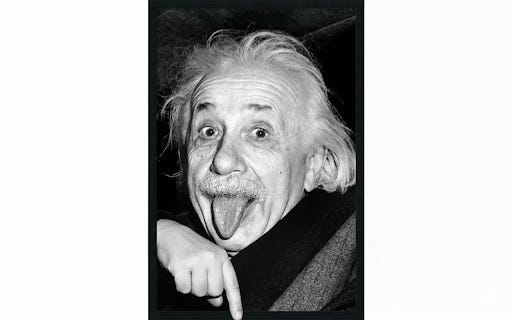
Indeed. “Everything” includes behavior.
Voilà. 👇🏻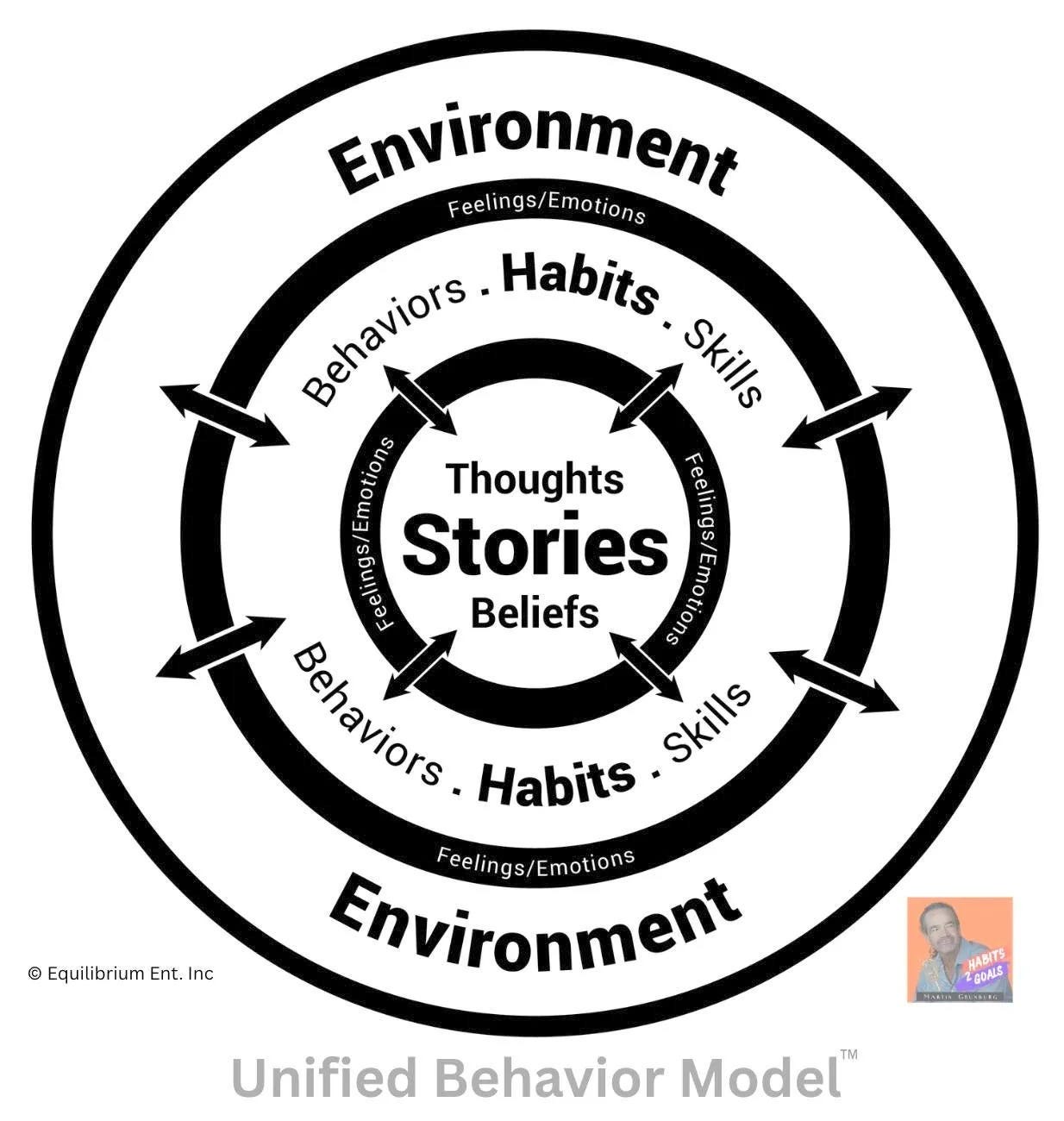
Unified Behavior Model (UBM) —Elemental Sufficiency results in UNIFICATION, ‘allegedly’
ENVIRONMENT (including your body) ‘sits’ on one ‘side’ of behavior.
Confused? Consider a toothache.
Does it not shift your feelings, behaviors, even your thinking? You bet it does.
That’s your body acting as an environmental stimulus — same as a blaring siren, a stranger’s cologne, or someone chewing too loudly next to you.
Any of these affects how you think, feel, and behave.
Body = Environment (behaviorally speaking). Get it?
Now, on the other “side” of behavior?
THOUGHT — COGNITION — STORIES.
It’s all of those real and imagined narratives you tell yourself about everything: who you are, what you can become, what you’re capable of.
“Behaviorally speaking” (that’s a crucial phrase), after all, this is a behavior model — not a model of a person.
Behaviorally speaking, your behaviors are “bookended” by just two elemental forces: Environment and Thinking.
That’s elemental sufficiency.
What about emotions and feelings!?
Well, to put it simply, they are both the most important and the least important influencers of behavior.
When it comes to emotions and feelings, it DEPENDS; they are variable.
Emotions and feelings are not considered long-term major elements.
Instead, at any moment, they are either the most or least important behavioral forces.
So, what was the one “thing” you identified that influences your behavior?
Did you say motivation? Or frustration? Or love?
Let’s take them top-down:
Motivation = Feeling.
Frustration = Feeling.
Love = Feeling.
Each is accounted for within the “Behavior Echo-System.”
Love?
Love is a complex phenomenon that touches upon — and/or emanates from — the entire behavioral system. It’s felt in the body, it’s an emotion, and it’s often a form of cognition. Behaviorally speaking, the Behavior Echo-System accounts for all of it.
Motivation?
Somewhat similar. Motivation is a feeling — an emotion — that may arise as a complex blend, including the body’s physical state (i.e., the environment).
Maybe you’re low on food. Low on energy. Maybe you’re stuck inside a debilitating story.
Again: behaviorally speaking, motivation fits squarely within the Behavior Echo-System.
Frustration?
Typically, frustration comes from a desire — a goal or ambition — that isn’t being met, or is being delayed.
This is a feeling — accounted for in the Behavior Echo-System — and may emerge from one or more elements, as a blend or derivative.
Often, the “environment” is the culprit behind frustration.
Back to feelings and emotions…
They don’t necessarily dictate or control behavior.
If you’ve ever done something incredibly dumb because you were enraged or upset, those emotions and feelings got the better of you in the MOMENT.
If you’ve ever done absolutely NOTHING — even while being incredibly angry, enraged, or upset — you demonstrated how emotions and feelings are VARIABLE — behaviorally speaking, of course.
Since UBM is a goal-directed behavior model, when it comes to your long-term goals, your daily emotional upswings and downswings carry less weight OVER THE LONG RUN than your environment and your thinking.
Say it with me:
Over time — months, years, decades — it’s not my daily emotions or feelings that determine the outcome of my long-term goals.
That’s it.
That’s the entire “Behavior Echo-System.”
JUST. FOUR. ELEMENTS.
And that brings us back to ELEMENTALISM.
Why hasn’t behavioral science been able to UNIFY?
This could very well be why.
It’s difficult, dare I say impossible, to find another ELEMENTAL, UNIFIED behavioral model!?
LOOK VERY CLOSELY…

Shocker Vedantam!!??!?
Could this be why?!
Not another elemental behavioral model to be found, anywhere?
I know — it’s actually Shankar Vedantam, host of NPR’s Hidden Brain, who’s spent years uncovering the hidden forces behind human behavior.
Maybe that’s the appropriate name drop and response…
That’s the twist. Get it?
That is THE genuine SHOCKER!
After more than a century of branching theories, therapies, and models in behavioral science, there’s “allegedly” just one ELEMENTAL, unified behavioral model.
It appears the key to solving the unification riddle was hidden…
…within complexity itself.
Now — I promised this applies to YOU!
You’re intelligent.
and good looking!
AND, you have goals.
Perhaps you lead others — organizations, teams, or both.
So, I’ll allow Claude.AI, UBM’s toughest critic, to take it from here.

A 30% increase in goal probabilistic outcome!?
You say, “That’s impossible — HOW CAN THAT BE!?”
All because it’s… you guessed it:
Elemental. Unified.
Go ahead. PLEASE.
Test it. Break it.
Improve it.
And, while your at it, show me the other unified, elemental model, please.
And be sure to keep on trackin’ ✅
~mg
👉 UBM — Beyond the white paper » Catch a free UBM Training/Webinar ON DEMAND! Just go to MAVEN.com add yourself to the “Course Updates.” That lets me know you’re interested in the free UBM Training/Webinar ON DEMAND. (No commitment whatsoever for the Habit Mastery cohort) and I’ll send you a custom invite/link!
All truth passes through three stages:
First, it is ridiculed; second, it is violently opposed; and third, it is accepted as self-evident.
Dramatic, I know. 😉
📄 Grab the now legendary habits-to-goals tracking template: thehabitfactor.com/templates
(Looking at you, top psych departments-according to U.S. News & World Report, 2025): @StanfordPsych, @HarvardPsych, @UCBPsychology, @UCLPALS, @Psych_at_Yale, @UMichPsych, @UCLA_Psych, @UCSDPsych, @OxfordPsych, @PrincetonPsych.
GOOD HABITS HAPPEN WHEN PLANNED;
BAD HABITS HAPPEN ON THEIR OWN.
Get the white paper here at Zenodo.org: https://doi.org/10.5281/zenodo.15844153
“Great theories have simple pictorial representations.”
-Michio Kaku
🚨 BREAKING! Major breakthrough in habit tracking news! -Skeptics, at long last, put to rest. Full details in Section 7.0 of the Unified Behavior Model™ white paper: https://zenodo.org/records/15844153
Learn more about The Behavioral Literacy Project & Unified Behavior Model: An Elemental, Falsifiable Framework for Behavior Change
Originally published at https://habits2goals.substack.com.